Travels and the Anxiety I Pack with Me
I’ve been fortunate to travel to every continent on Earth except for Antarctica. While this sounds incredibly pretentious (it is), I bring it up because it suggests that I have spent a good chunk of my life on airplanes and at airports. And, if my memory serves me correctly, I have never missed a flight.1 Famous last words. While I have had my fair share of running around in airports to catch connecting flights, I refuse to put myself if a situation where I am not at the airport hours before my first flight is scheduled to leave, no matter the size of the airport.2 To be clear, this applies to train stations as well. When I was in China, traveling from Shanghai to Beijing, I got to the train station almost two fucking hours before the train was scheduled to leave. Nobody does that. The issue is that traveling ruins my entire day because, up until the flight, I am irrationally anxious. It begins as soon as I wake up and slowly builds up throughout the day. The only time when my travel anxiety eventually subsides is when I’m sitting in my seat on the airplane with my seat belt fastened.3 I’m sorry about all the god-damned footnotes but I don’t know where else to put this: after I sit down, I don’t get up from my seat. Ever. Not to pee. Not to stretch my legs. No reason short of leaving the airplane after landing.
By now, it has become a point of pride for me. I’ve been on 16-hour continuous flights without even considering the possibility of getting up; I’d rather end up like this poor bastard than ask my neighbor to let me out so I can relieve myself.
Like people, airports vary in all sorts of sizes and shapes. Some have a single terminal while others have multiple. Some have trains connecting these terminals together (e.g. Denver International Airport) and others make you walk (run?) distances on the order of actual miles (London is a classic example) to get from Terminal A to B. As I’m sure most of you know, the bigger an airport is, the more people there likely will be, and the bigger the pain-in-the-ass security will be to get through. For the smaller airports, with a single terminal, security is usually a breeze.
Logically, if small airports take less time to go through then I don’t need to give myself so much spare time to pass through security, right? I know this but I don’t really change anything in my pre-flight routine. And this uncompromising need to get to the airport early drives the people who I travel with absolutely fucking bonkers, though nobody ever says anything to me. But I don’t care. Being the thoughtful, considerate guy that I am, I make them suffer in Eighth-Amendment-violating boredom at the airport gate for my comfort.
Let me give you an example. During the summer of 2019, I was in Indonesia where I was island hopping with my good friend. The hostel we were staying at sent a shuttle every hour to the airport and this is what 99% of the people who stayed at that hostel did to get to the airport. But not us. We looked it up and realized the airport was only a 30-minute walk away. The shuttle wouldn’t come for another 45 minutes. My friend, bless her heart, could tell I was anxious to get to the airport even though our flight wasn’t for another three to four hours or so. Teasing me, she asked if I wanted to go. I said yes. And we got up, put on our backpacks, and started walking.4 As I write this, I realize how patient she was with me. I didn’t appreciate it at the time (because the travel anxiety crippled my sense of gratitude—also, I’m just an asshole in general) but I do now.
Like clockwork, we arrived at the airport a whopping 15 minutes before the rest of the suckers at the hostel who took the shuttle. In that time, we had checked in, got our tickets, and absolutely breezed through security. Checking my watch, I saw we were cutting it close with only two-and-a-half-hours to spare.
To give more context on how absurdly early we got to this airport—for this flight in particular—I should tell you that when I said I was “island hopping” two paragraphs ago, I meant flying from the west part to the central part of the same island. The actual flight time was probably 30 minutes or fewer, giving us an airport-wait-time to flight time ratio of more than 5:1. But luckily, my friend came prepared, buying a $0.30 pack of cards the previous day. With these cards, she showed me a card game that I had never heard of but which ended up occupying an embarrassing amount of my time ever since. The game is called Clock Solitaire.
Clock Solitaire—How to Play
Clock Solitaire5 It goes by other names as well, such as Clock Patience, Patience, Clock, and Travellers. is a game, as one YouTube video describes it, that is “… a fun and interesting variant of solitaire. While simple to play, it’s rare to win this solitaire game as it is almost entirely driven by luck.” Umm, Anonymous YouTube voice, no. You’re wrong: Clock Solitaire is not fun; at best, it is moderately interesting; and, finally, it is not almost entirely driven by luck, it is entirely driven by luck—assuming you play properly, but we’ll get to that at the end.
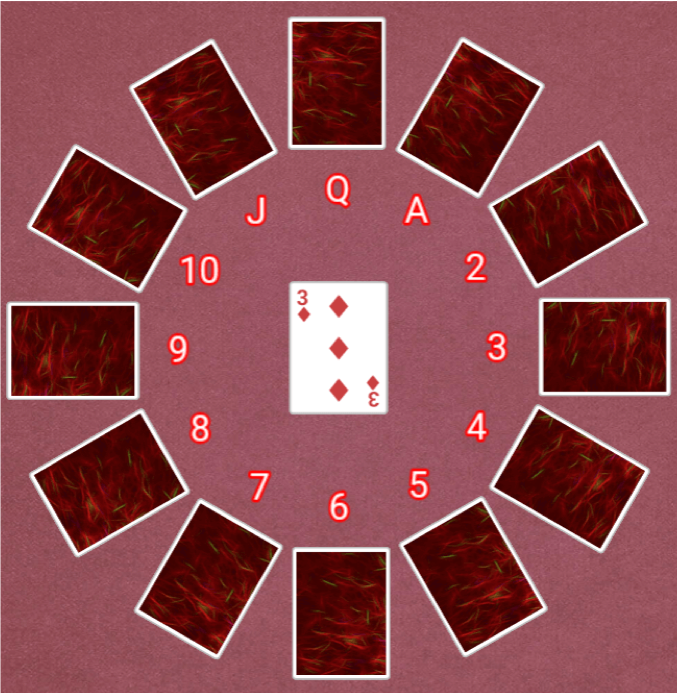
The rules of the game are pretty simple:
- Shuffle the deck properly.
- Place 12 piles of four cards each faced down in a circle and leave the remaining four cards in the center. Each pile on the circumference represents the face of the clock and the center pile represents the hands of the clock. At the one o’clock position is the Aces’ Pile, at the two o’clock position is the Twos’ Pile, and so on. The center pile is the Kings’ Pile.
- Flip over the first card on the Kings’ Pile. (In the image above, this would correspond to the three of diamonds that is shown.)
- Place the first card under the appropriate pile (in the above image, the three of diamonds would go to the bottom of the Threes’ Pile still facing up) and turn over the top card of that same pile.
- Repeat this process until the game ends. Either you win when all the cards have been played or you lose when the fourth King is turned up before all the other piles are emptied of faced down cards.
As you may be able to figure out by reading the rules, Clock Solitaire is entirely determined once the shuffle of the deck has been completed—it’s just a mechanical motion of following rules after that and there is literally no skill involved.
After my friend taught me the rules, I watched her play a game. It seemed like it was going pretty well—whatever that means in a game of zero skill—until about 80% through, she picked up the fourth king and couldn’t continue the game. So she lost. Then I watched her play again. Same result. Puzzled as to why she kept playing, I asked her if she realized that this was a game that was essentially random, dumb luck. She said she that knew, but she liked to play anyways. It was a good way to pass the time and, by my count, we had two hours until we could even board our plane. I think I ended up playing a game where I lost too.
I don’t remember the specifics but after a few more games of Clock Solitaire, one of us brought up the question as to what percentage of games end in victory. I said it should be relatively straightforward to figure out since we could just write a program to simulate a million games or so and count how many ended up winning.6 While writing this unnecessarily lengthy post, I found a website where some innumerate says that the chance of winning is only about 1%. I don’t want to call anybody out but I don’t know where the author, Erik Arneson, pulled that number from; he is just wrong. The funniest thing is that he wrote books about games and if had he just read the Wikipedia page, he could have found the actual chance of winning.
Now, the astute reader may point out that I too could have just read the Wikipedia page and saved myself a lot of time. Well, yes. But, fuck you for bringing it up. Since Clock Solitaire is—unsurprisingly—a solitary game, we ended up playing a two-player game while we waited—it, too, requires zero skill and is entirely mechanical: War.7 After graduating college, I moved into a house with some friends since we were all going to work at the same company. One of my housemates told me a story about the family tradition of a girl he dated in high school. Around the holiday season, his girlfriend’s family (grandparents included) would each give a presentation on any topic that they wanted to. Apparently my housemate’s ex-girlfriend really likes War or, at least, thinks it’s a worthwhile game. Like any sane person, my housemate thinks it is one of the dumbest games that have ever been invented and they had arguments (like the types of arguments you pretend to not care about but actually do—you know the “joke” arguments) about it previously. So he took the opportunity to make a 10-minute PowerPoint presentation explaining to her whole family why War is a dumb game. When asked if he won the argument, he only laughs. Apparently, her parents and grandparents thought he did a stellar job and “really knocked it out of the park.” You can probably guess how she felt about that. Eventually, we got on the plane and moved to the next portion of our adventures but I could never get Clock Solitaire quite out of my head. Even a few weeks later, it was churning about in there.
Patience: Or, Sitting, Thinking, Waiting
Fast forward a month or so: after traveling, I came back to the good old U.S.A. where I started my first “real” job. The trouble was that I was bored out of my mind when I arrived home since I had a good chunk of free time now. Instead of doing something productive, like tutor math and science for local middle and high school students,8 After writing this sentence, I felt guilty. So I signed up to be a tutor. Perhaps there will be a post about that in the nearish future. I sat around thinking about Clock Solitaire and the unanswered question about the win percentage associated with it. While I was supposed to be working, the answer hit me: since Clock Solitaire is completely determined after the shuffled deck has been dealt, you could imagine playing the game backwards rather than forwards. So the only way you can win is if the last card comes from the Kings’ pile which, when randomly chosen in general, is just 1/13. Thus, you expect to win about once every thirteen games you play. I thought that was a pretty cute result and I was proud of myself for figuring it out, but I wasn’t 100% confident in my answer. Like a coward, I decided to check it numerically.
I figured this would be a good excuse to brush up on my Python or even learn a new programming language. After an admittedly embarrassing amount of time,9 I really don’t want to talk about it but it took long enough to convince myself that I won’t do anything worthwhile with my life. I managed to write some very inefficient code that simulated a game of Clock Solitaire in Python. It worked but it was, you know, slow. Instead of making the algorithm faster, I punted and chose to write it in Julia, a language which claims to be faster and which I had been meaning to learn for quite some time. It was a convenient enough excuse to learn.
The reason I wanted a faster language is because I originally told my friend—way back in Indonesia, months ago—that I would simulate a million games of Clock Solitaire to find the win percentage. But, I decided that wasn’t good enough; I needed to be sure that I was right. So instead, I simulated a million games a million times. That is, I “played” a trillion games of Clock Solitaire.10 I’d like to give some context between playing a million games and playing a trillion games. At some point, the human brain sort of just lumps all big numbers together so I think it’s worth exploring.
My math teacher in high school was teaching us about probability during my sophomore or junior year. At some point, we calculated the odds of winning the lottery. I don’t remember the details surrounding the calculation, but I remember we found the odds were about the same as if you incremented the highway in inches from my city to a city that was 80 miles away: about 1 in 5 million. A good way to visualize the likelihood of winning would be for you to walk along the 80-mile stretch of highway and place a single quarter (which has a diameter of 0.95 inches, roughly an inch) on the ground and say, “That’s my inch!” and see if you picked the same inch that the lottery folks did. Similarly, a trillion inches would be akin to taking a silver dollar between mercury and the sun and placing it in the vastness of space. It’s utterly incomprehensible. A better example might be a comparison using time: a million seconds takes about 11 days and 14 hours to complete. A trillion seconds take 31.6 years to occur. And it took a long time to “play” this many games.11 My dad is a computer guy who has a bunch of old laptops laying around his house. In an effort to not be wasteful, he tried to make his own server using OpenStack with them. I was hoping to let these trillion games run on his server. Unfortunately, each laptop has to have a certain amount of memory and the ones that he has don’t meet the minimum memory requirement so I could not do this. This made me sad. Using my laptop as a sacrificial lamb, I hit run. I waited. Got some coffee. Came back. Waited some more, then went to sleep. I came back the next day but it was still running. So I waited again. The same thing. After a few days, I decided it was probably worth getting on with my life. And I did. But the whole time, my laptop kept humming along….
While I came back to the United States, my friend continued traveling around Asia. Thinking ahead, I asked her to keep track of her Clock Solitaire wins and losses so we could compare answers later. While she played significantly fewer games (about 20) than I ended up “playing”, she had win percentage of a whopping 25%. How is that possible? I asked if she shuffled the deck after she won once. She said she did. I was suspicious but I let it slide.
On Day 11 of the trillion simulations, I read a short story called The Giocanda Smile by Aldous Huxley just before bed. As I was reading, I stumbled across a sentence that made me nearly drop my book. Like a ghost haunting me, the story talked about Clock Solitaire. It said,
This made me suspicious that my friend may be a card cheat….
The Results
One day the humming of my laptop stopped and I checked the result.
In total, it took 1,327,205 seconds (or roughly 15.36 days) to complete all of the games. My results found, on average, you would win 7.6923463497% of the time. The average number of cards you played per game was 42.400004531036004. For comparison, the decimal form of 1/13 is given by 0.07692307692…. So I’m pretty confident that I’m right. I also could have just went to this website and saved myself some effort,12 And crippling my self-worth. but such is life.
So the big question: Is my friend like Mrs. Hutton? Was she fudging what cards go where? Could she do such an evil thing? I had to know.
To do so, I put on my statistics hat and tried to find out. Since she played 20 games and won five of them, she had a win percentage of 25%. Since we are counting wins/losses, we really need to look at the distribution of these wins and losses. An approximation of the uncertainty for these discrete events, in terms of win percentage, is given by one over the square root of the total number of games played.13 Since I played a trillion games, my error bars are ± 0.000001 So, in reality, her “win” percentage had some fat error bars and her actual results can be described as 0.25 ± 0.2236…. Recall that 1/13 = 0.07692307692…, which falls between the upper and lower ends of her result. Consequently, I didn’t have enough evidence to call her a dirty card cheat which makes sense, too. She’s one of the most honest people I know.
Wrapping Up
Like most of my posts, this was a long-winded, poorly-written, unorganized, chaotic tale of self-discovery that had a beginning, took a wide, wrong turn, and never came back. Why did I—or anyone would, really—get obsessed with a fundamentally boring game? Why did I devote so much of my time to it? I don’t have an answer. I’m not even sure why I’m writing about it to you. However, despite it all, this little adventure of mine taught me a lot about patience—about twiddling your thumb at useless things that maybe aren’t so useless after all. And good thing I did because I have been in two separate months-long battles: one with California’s DMV about my pink slip and the other is a battle killing with myself, that is, I have a plantar wart on the bottom of my foot which—god almighty—is almost dead.
So if by some miracle, you managed to (1) find this website, (2) clicked and read this post, and, lastly, (3) finish this post,14 You’re so close! I imagine that you’re thinking to yourself—what a gigantic waste of my time. Now you can imagine how I felt about all this as well.